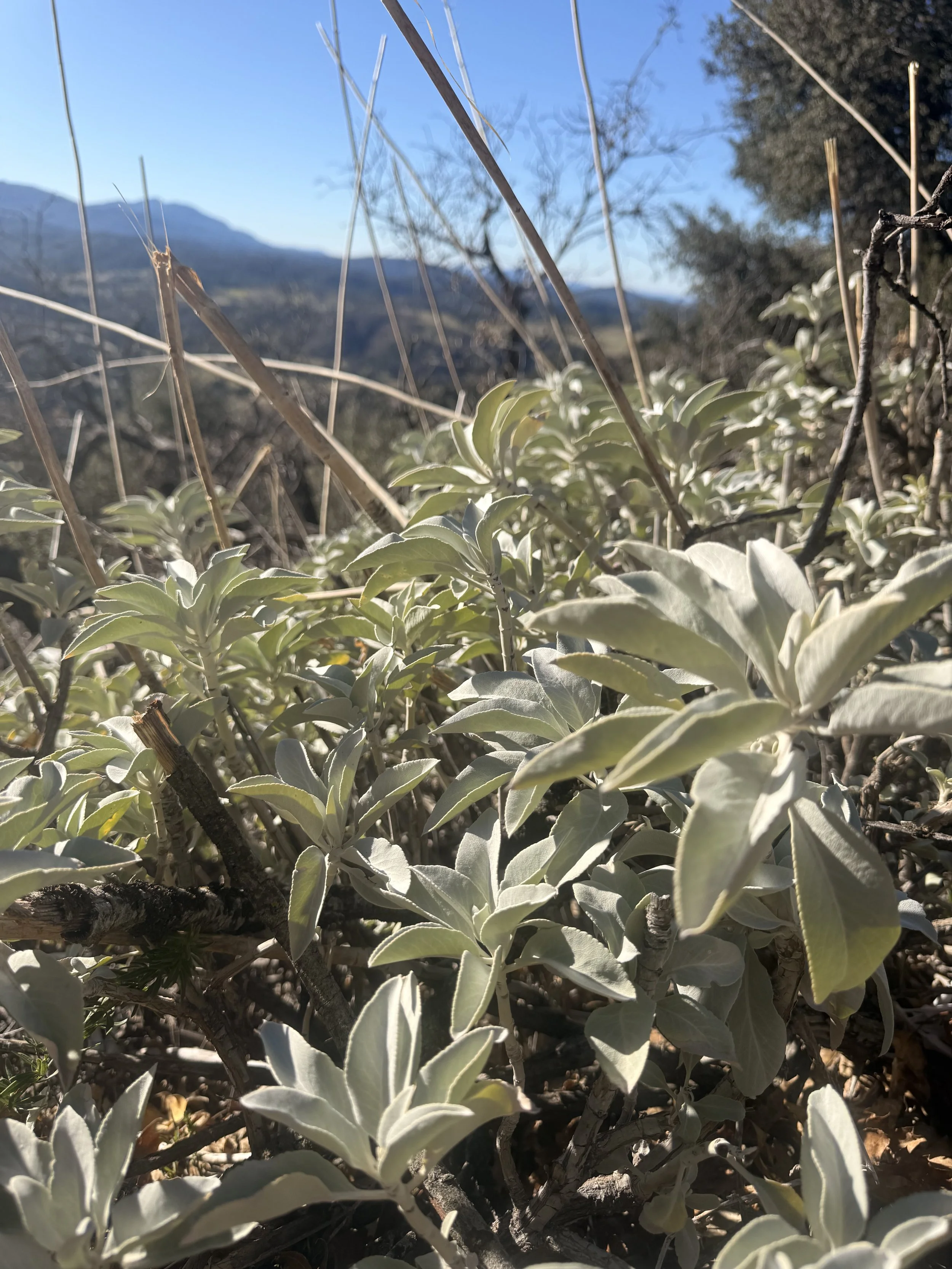
There is something about the wild sage growing across the hills of Southern California that draws me in. It feels ancient and oddly familiar, as though the land remembers a wisdom we tend to forget in our long pursuit of understanding ourselves.
As I step into a new chapter of my life and work, I find myself returning to teachings that have quietly been part of my heritage all along.
For years my work as a clinical counsellor in Canada was rooted in the psychological mind. I studied trauma and attachment, sat with clients as they untangled their histories, and learned to read the language of the nervous system. That training shaped me, and I remain grateful for it. Yet somewhere along the way, through my own evolution as much as my professional one, I was drawn toward the place where psychology meets spirit and consciousness. I don't see this as leaving modern psychology behind. It feels more like the walls of the room have opened.
Discovering Vedic Psychology
One of the voices that has walked with me on this path is Dr. David Frawley, known in India as Vamadeva Shastri. His book Ayurveda and the Mind is still one of the clearest bridges between the Vedic tradition and the Western reader. It carries the subtitle The Healing of Consciousness, and that phrase has stayed with me.
In the Vedic view, the mind is not the whole of who we are. It is a subtle instrument, finer than the body yet still part of nature, and behind it stands pure awareness, the witness the tradition calls Purusha or the Self. Frawley describes this inner instrument in four layers. Chitta is the deep field of memory and conditioning where impressions settle. Manas is the outer mind that gathers sensory input and reacts to it. Buddhi is the discerning intelligence that can see clearly and choose. Ahamkara is the sense of "I" that claims each experience as its own. From this perspective, much of our suffering comes from identifying wholly with the restless movements of manas and ahamkara, while buddhi sits underused and the witness goes unnoticed.
The Gunas and the Food of the Mind
Ayurveda offers the three gunas as a way of reading the quality of the mind in any given moment. Sattva is the luminous quality, the state in which we can observe ourselves with compassion and respond rather than react. Rajas is movement and desire. It is the fire that lets us create and pursue, though in excess it becomes agitation and an inability to simply be. Tamas is heaviness and inertia. We need it for sleep and restoration, yet in excess it settles into stagnation and a dull sense of disconnection. These are not personality types, nor are they diagnoses. They shift through the course of a day and across the longer seasons of a life.
What moved me most in Frawley's writing is his insistence that the mind is fed just as the body is. Alongside the food we eat, he speaks of the impressions we take in through our senses and the company we keep as nourishment for consciousness. A mind steeped in screens and constant noise will lean toward rajas, while a mind left in isolation drifts toward tamas. Sattva grows from what we choose to let in. That changes the therapeutic question entirely. Rather than asking only what happened to us, we begin to ask what we are feeding, and what conditions we are cultivating within ourselves.
What Vedic Counselling Looks Like
Vedic counselling begins from this wider picture. A Vedic counsellor looks at a person's constitution and daily rhythms, at diet and sleep, at the sensory world they live in, at the relationships that nourish or deplete them, and at the deeper question of dharma, the sense of purpose that gives a life its direction. The remedies reach well beyond conversation. Breath, mantra, meditation, colour and aroma, time in nature, a change in daily routine, devotion and service all become ways of working with the mind. The aim is less to repair a disorder than to cultivate sattva, so that the person's own discerning intelligence can do much of the healing.
The counsellor's own state matters here too. In the Vedic understanding, a guide works as much through presence as through technique, and a settled mind in the room becomes a kind of medicine.
What Western Psychology Might Learn
I want to tread carefully here. I owe a great deal to Western psychology, and I don't believe one tradition needs to diminish the other. Still, when I hold them side by side, a few gifts from the Vedic view feel worth offering back.
The first is a positive picture of mental health. Much of Western psychology grew out of the study of pathology, and our language still leans toward symptoms and disorders. The Vedic tradition starts from the other end. It describes a clear and peaceful mind as our natural state and asks what is obscuring it. That shift alone can change how a person relates to their own suffering.
Then there is the idea of a mental diet. We are only beginning to reckon with the effects of social media and chronic stress, yet the Vedic seers treated the intake of impressions as a matter of daily hygiene thousands of years ago. I sometimes imagine an intake assessment that asks about sleep and appetite and also about what a person watches and listens to before bed.
The Vedic tradition also offers a place to stand beyond the mind. Mindfulness and the observing self in Acceptance and Commitment Therapy have drawn, knowingly or not, on this ancient insight. Vedic psychology goes further and names the witness as our true nature. When someone realises they are the awareness in which thoughts arise, rather than the thoughts themselves, something loosens that insight alone rarely reaches.
Finally there is dharma. Many people come to therapy not because they are unwell but because they feel unmoored. The Vedic tradition takes that longing for meaning seriously, as a matter of the soul rather than a symptom to manage.
My years in practice taught me that we can understand our patterns and still repeat them, and that we can name our wounds with great precision while still feeling far from our bodies. Insight matters, but on its own it rarely transforms how we live. This is where my work has naturally moved, toward embodiment and toward an understanding of the human being that holds the energetic and spiritual dimensions alongside the psychological self.
A Return to My Roots
I have spent much of my life as a woman of Indian ancestry navigating Western cultures and institutions, so coming home to these teachings feels deeply personal. The wisdom of my ancestors is no longer something I admire from a distance. It is becoming the way I live and the way I hope to serve. Perhaps this chapter is less about becoming someone new than about remembering something that was always there.
Integrative & Vedic Guidance
Through Ritual Wellness Center in Rancho Santa Fe, I am opening this next chapter as Integrative & Vedic Guidance. The offering weaves my background in contemporary psychology together with Ayurvedic philosophy and somatic practice. It sits outside clinical counselling and psychotherapy. It is an invitation into inquiry and conscious living, a space to explore the stories that have shaped us and the qualities we wish to cultivate as we move forward. And perhaps it is a space to remember that we are so much more than the contents of our minds.
With love and gratitude,
Michelle